Elegy for a Stranger I Loved

Written by: Alessandra Joelle
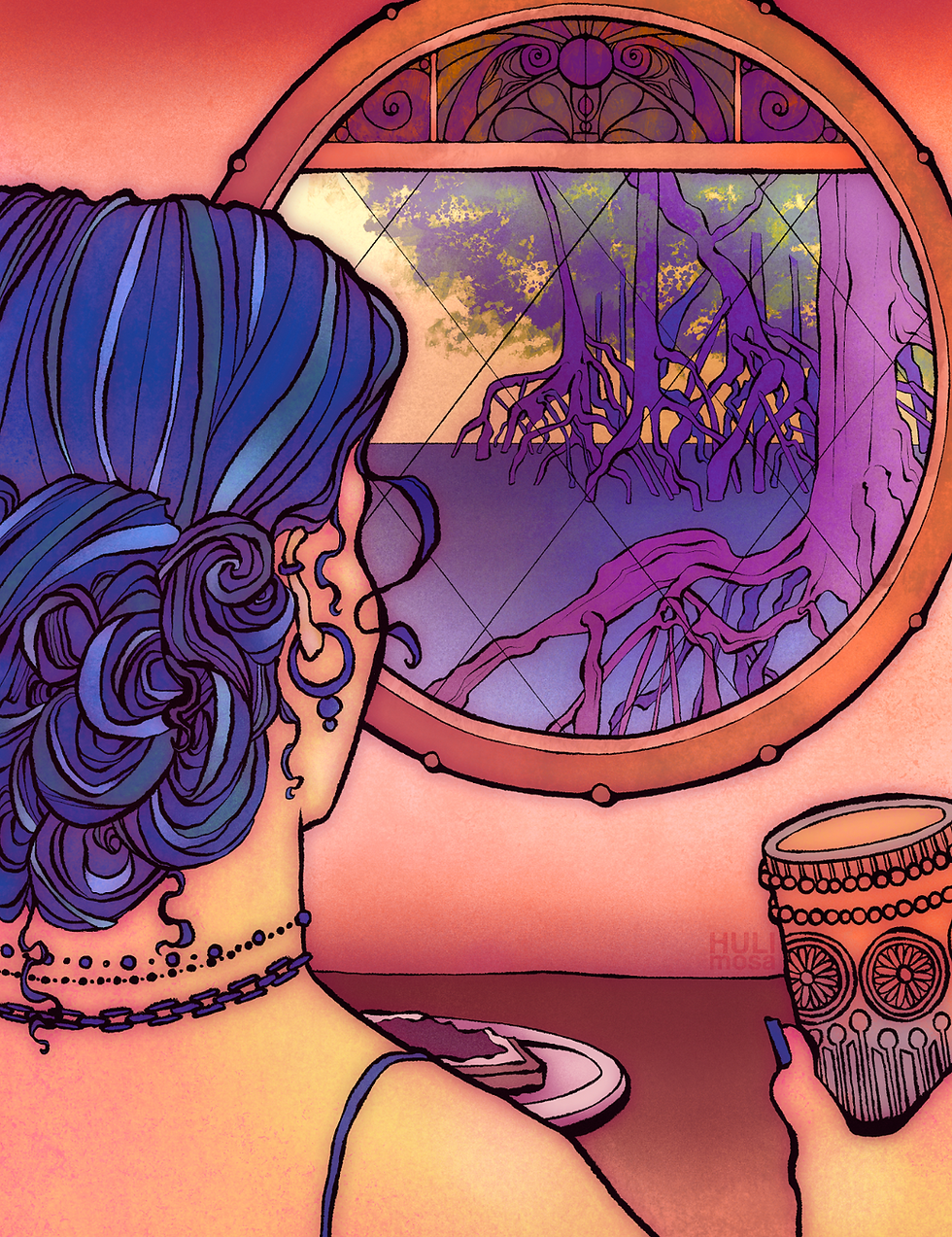
Art by: Andrea Lastimosa

There is a particular kind of grief that does not belong to us, yet settles into our bodies as if it does.
It arrives quietly—through interviews watched at midnight, through cracked voices on stage,
through lyrics that confess pain we have never lived but somehow recognize. Known as
‘parasocial grief’, a borrowed mourning, where the fan processes their own unresolved trauma by tending to the visible wounds of an artist.
We do not grieve with them. We grieve through them.
In a culture that rewards emotional exposure, artists become public vessels for private pain. Their heartbreak is legible, curated, repeatable. It has verses, timestamps, and documentary footage. Meanwhile, our own suffering remains inarticulate—too close, too raw, too undefined to face directly. So we redirect. We attach. We learn someone else’s pain by heart because it is easier to memorize than our own.
There is comfort in this distance. An artist’s grief comes with boundaries: it ends when the song does. It resolves in a bridge, finds redemption in a final chorus. Our own trauma rarely offers such structure. Parasocial grief gives pain a narrative arc, something to hold onto when our personal losses feel formless and endless.
Fans often describe this attachment as empathy, but it is more complicated than kindness. It is a form of emotional translation. When we say, I feel devastated for them, we are sometimes saying, I don’t yet have the language to grieve for myself.
This is not inherently unhealthy. In fact, it can be a rehearsal. Watching someone else survive
publicly can teach us how pain might look once it is survivable. The artist becomes a mirror
tilted just enough away from us that we can bear to look. Their songs articulate feelings we have been suppressing; their breakdowns legitimize our own quiet ones. Through them, grief becomes speakable.
But grief has a shadow.
When fans begin to protect an artist’s pain more fiercely than they protect their own healing,
mourning turns into identity. Trauma becomes fandom. Suffering is archived, analyzed,
aestheticized. The artist is frozen in their worst moment, endlessly revisited, while the fan
remains emotionally stationary—looping the same songs, the same interviews, the same ache, mistaking emotional intensity for emotional progress.
There is also a subtle erasure at work. Artists are reduced to their pain because that is where we need them most. Recovery, happiness, ordinariness—these feel like betrayals. If they heal, where does that leave the fan who was still using that pain as a place to rest?
Parasocial grief thrives in the digital age because intimacy is constant and consequence-free. We can witness devastation without being asked to respond responsibly. No casseroles to cook. No rooms to sit in. Just a screen, a comment section, and the illusion of closeness. We grieve loudly, communally, performatively—often without ever touching the source of our own sorrow.
And yet, there is something deeply human here.
We have always learned how to feel by watching others feel first. Stories, myths, songs—these have always been emotional intermediaries. Parasocial grief is not a modern invention; it is simply intensified by access. What is new is the scale, the permanence, the way an artist’s pain can become a permanent emotional refuge.
The question is not whether parasocial grief is real—it is. The question is what we do after
recognizing it.
At some point, the borrowed mourning must be returned. The artist’s pain can open the door, but we have to walk through it ourselves. We have to ask what in us responded so strongly, what loss we were translating, what we have been avoiding naming.
Because grief, ultimately, wants ownership—and healing begins not when we stop caring about others’ pain—but when we stop using it as a substitute for our own.

Comments